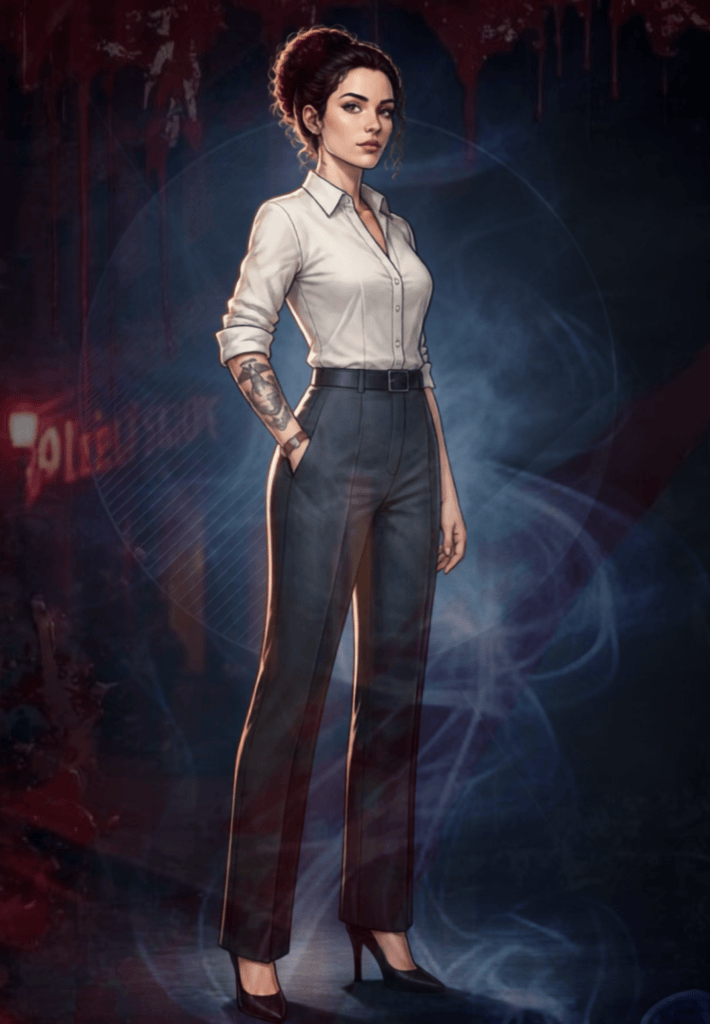
Secrets of the Harvest Chapter One
The heavy glass doors of the Behavioral Analysis Unit sealed behind Kate with a clinical hiss, the kind that always made her feel like she was stepping into a pressurized chamber. She paused in the corridor, spine straight, shoulders squared, chin level, the posture she’d worn like armor for a decade. A weapon, yes. But also, a machine held together by too many improvised repairs and not enough real rebuilding. The Marines had kept her functional, kept her moving forward without ever forcing her to look backward. Leaving them for the FBI had felt like progress, but she knew better. Trauma didn’t vanish just because you outran it. She pushed on anyway, heels striking the linoleum in a steady, metronomic rhythm as she headed toward the bullpen, each step a reminder that she could still walk into any room like she owned her damage instead of the other way around.
Michal Harris stood at the head of the central table, a neat stack of case files lined up in front of him with the kind of precision that said everything about the man. He looked like someone who stored his emotions the same way he stored paperwork, categorized, labeled, and locked away. He studied a tablet, brow drawn in concentration, the expression of a man who handled crises by breaking them apart piece by piece.
“Agent Russo,” he said without looking up. His voice was a low baritone, smooth and controlled. “Three minutes early. I appreciate that.”
“Efficiency is the only currency that doesn’t lose value, sir,” Kate replied, clipped and steady. She stepped just far enough into his line of sight to be acknowledged, keeping a deliberate four-foot buffer between them. The air hummed with the static of two professionals quietly testing the boundaries of authority.
Michal finally lifted his gaze. His eyes were cool, assessing gray, not dismissive, not impressed, just measuring. “I reviewed your transfer file from Quantico. Your linguistic analysis scores are exceptional. Your field reports, however, are… minimal. You don’t elaborate on your methods.”
“My process is data, sir,” Kate said. “The narrative is optional.”
He leaned back against the edge of the desk, arms crossing in a way that pulled his button‑down smooth across his chest. He didn’t look like a man who lived at the office. He looked like someone who went home to silence and unfinished chapters — the kind of quiet, domestic ghosts that linger when life veers off course. “The Bureau isn’t just data points,” he said. “It’s human behavior. You can’t profile someone if you insist on staying behind a glass wall.”
Kate felt her internal alarms flicker to life — not loud, but insistent, like a static charge under her skin. Her gaze drifted to the desk. A leather-bound planner lay open, and tucked into the side pocket was a laminated photo of a young boy with wild hair and a gap‑toothed grin.
Alexander.
A sharp, unwelcome heat flared in her chest — envy, quick and bright — followed by the cold recognition she hated even more. She knew that look. She knew how a parent carried a child’s photo when they were terrified of losing the thread that tied them together.
“I’m here to work, not socialize, sir,” she said, her voice dropping lower, cooler.
Michal caught the direction of her glance. Something in his expression eased — not much, just enough to show there was a person under all that discipline. He didn’t hide the photo or slide it away. He let it sit there, a quiet admission. “I’m a single father, Kate. I spend my days in high‑stakes chaos, and then I go home to a four‑year‑old who thinks the world is made of playgrounds. It keeps me steady. Reminds me why any of this matters.”
“It must be… distracting,” she said, the word catching in her throat before she could smooth it out. Her fingers tightened around the strap of her laptop bag until her knuckles were blanched. His openness felt like an intrusion, a quiet pressure against the walls she’d spent years reinforcing. Vulnerability demanded reciprocity, and Kate didn’t have anything to give. She wasn’t about to admit envy. She wasn’t about to admit that the one thing she’d ever wanted, a family, a life that didn’t feel like borrowed time, had been denied to her again and again.
“Distraction implies I lose focus,” Michal replied, his voice shifting into something warmer, less ‘Chief,’ more man. He stepped closer, closing the distance to three feet. Not enough to crowd her. Just enough to make her aware of him. “If anything, it sharpens me. Knowing what’s worth protecting makes it easier to see what’s trying to tear it apart.”
Kate looked away, tracing the geometric pattern in the industrial carpet as if it held answers. She could feel him watching her, not in a predatory way, but with a kind of steady, attentive gravity that made her chest tighten. She’d spent her entire life keeping people at arm’s length, using intellect as a barricade and cynicism as a shield. But Michal Harris was looking at her like he could see the fractures beneath the surface… and worse, like he wasn’t afraid of them.
“I prefer the data,” she said again, but the conviction in her voice was thinning, fraying at the edges.
Michal didn’t push. He didn’t soften, either. He simply held her gaze when she finally looked up, his expression steady, patient, the kind of patience that suggested he’d already learned how to navigate people who lived behind reinforced emotional walls.
“Data’s clean,” he said quietly. “People aren’t. But you already know that, Agent Russo.”
The way he said her name made something in her chest shift, not enough to break, but enough to remind her that cracks could widen if she wasn’t careful.
Kate held his gaze, the last thread of her composure stretched thin. “Data doesn’t lie,” she said, quieter this time, as if she needed the words to anchor her.
Michal’s expression shifted, not a smile, not a challenge, just a soft acknowledgment that landed deeper than she wanted it to. “We’ll see,” he murmured. He turned back to the files, but he didn’t turn away from her. His body stayed angled in her direction, an unconscious tell she wished she hadn’t noticed.
“Get settled, Agent,” he continued, flipping open a case folder with practiced precision. “We’re deep‑diving into the Iowa backlog this afternoon. Jurisdictional nightmares, cold leads, local authorities who’d rather pretend the shadows aren’t real.” He glanced at her again, the weight of his attention deliberates. “I’m going to need you to be more than a computer. I need you to see what everyone else keeps looking away from.”
Kate’s chin lifted, her voice steady even as something inside her wavered. “I’m not afraid of the dark, Chief.”
His eyes locked onto hers, steady, assessing, and threaded with something she couldn’t name. The air between them thickened, charged with an understanding neither of them had earned yet. There was a dare in his gaze, an invitation she had no intention of accepting but couldn’t quite ignore.
She held his stare a beat longer than protocol allowed, a dangerous, fluttering moment where curiosity brushed against caution, before she forced herself to break the connection. Turning sharply, she walked toward the small, empty desk assigned to her, heels tapping out a rhythm that sounded far more confident than she felt.
Behind her, she could still feel his attention, like a hand hovering just above her spine.
Kate sat down at the small desk, pulling her laptop from her bag with movements that felt too controlled, too practiced. She didn’t open the files right away. Instead, she stared at the blank, black screen, her own faint and ghostlike reflection in the glass. The woman looking back at her appeared capable, composed, every line of her posture telegraphing professionalism. But behind the eyes, deep in the unlit corridors she never let anyone walk, she felt the old chill rise.
Iowa.
Cornfields stretching into forever. The metallic tang of ozone before a storm. Wind that sliced through thin jackets and thinner childhood defenses. And footsteps, always footsteps, someone else’s weight pressing into the dirt behind her.
She inhaled slowly, forcing the memories back into their box. She wasn’t that foster kid anymore. She wasn’t being dragged out to work fields until her fingers went numb. She wasn’t powerless.
Her fingertip tapped a key, and the screen flickered to life. A list of missing children populated the display, each name a wound waiting to be reopened. The first file belonged to a girl who had vanished at age four.
Four. The exact age Kate had been when her world had snapped in half.
Her breath stuttered, jagged at the edges. She steadied herself, shoulders tightening. She wasn’t that girl anymore. She was an FBI profiler. She was sitting in a federal office with a badge, a gun, and a mind sharp enough to cut through lies like wire.
And she was under the command of a man whose intensity made her pulse jump for reasons she didn’t have the luxury to explore. Reasons she refused to explore. Attraction was dangerous. Attention was dangerous. And Michal Harris looked at her like he saw more than her résumé, like he sensed the fractures she’d spent years burying under discipline and data.
She wouldn’t let him. She couldn’t.
People found out about her past and everything changed. They treated her differently, handled her like she was fragile, broken, something to pity or fix. She’d learned to keep her history locked away, sealed behind the same reinforced walls she used to keep herself upright.
Kate exhaled, long and controlled, and opened the first file.
She would do the job. She would stay sharp. She would stay distant.
Whatever Michal thought he saw in her, he wasn’t going to see more.
She forced the thought back into the vault where she kept everything dangerous, pulling cold efficiency into her bloodstream like oxygen. She was here to hunt. And if this case demanded she walk straight into the shadows of her own past to find the monster hiding there, she would do it. She’d walk through fire if that’s what it took. She’d done it before.
Across the room, Michal watched her. He didn’t stare, he observed, the way seasoned agents did when they were trying to understand the shape of someone’s pain. He saw the tension in her shoulders, the millisecond tremor in her hand before she steadied the mouse. He recognized trauma when it flickered across a person’s body like static. He knew what it looked like when someone held their life together with sheer, frantic willpower.
He wasn’t sure why it hit him so hard. Why the moment she’d walked through those glass doors, something in his own life had snapped into focus. The lonely nights. The constant worry for Alexander. The bureaucratic grind that had been wearing him down for years. All of it had shifted the second Kate Russo stepped into the room, like she’d pulled the air into a different alignment.
He had a feeling this assignment was going to be the most dangerous thing he’d ever taken on, and it had nothing to do with the killer they were chasing.
The BAU bullpen hummed with the low drone of server fans and the staccato rhythm of keyboards. Kate stared at the case file glowing on her screen, but her mind was already moving somewhere deeper. Her eyes traced the linguistic syntax of the ransom notes left behind by the Iowa predator. To anyone else, they were crude, illiterate scrawls. To her, they were blueprints, patterns of deprivation, desperation, and a very specific kind of psychological starvation.
She leaned closer, reading between the lines, feeling the familiar pull of intuition sharpen. The phrasing. The cadence. The way certain words were repeated, not out of ignorance, but out of compulsion. She knew this kind of mind. She knew the way it fractured. She knew the way it hunted.
And she knew the way it created victims who learned to survive by disappearing into themselves.
Kate swallowed hard, her pulse steadying into something cold and precise. She wasn’t that child anymore. She wasn’t prey. She wasn’t powerless.
She was the one doing the hunting now.
And somewhere behind her, she could feel Michal’s gaze, steady, protective, and entirely too perceptive, like a hand hovering just above her spine, close enough to sense but not close enough to touch.
She ignored it. She had to.
Whatever he thought he saw in her, whatever connection sparked in the air between them, she wasn’t going to let it grow roots. She’d learned a long time ago that once people found out about her past, everything changed. They treated her differently. They handled her like she was fragile, breakable, something to pity or fix.
She wasn’t any of those things.
She was here to do the job.
And she was going to find the monster in those cornfields, before it found another child.
Agent Ben Carter stood a few feet away, arms folded tight across his chest, watching Kate with the kind of clinical skepticism reserved for someone he was already convinced would tank their clearance rate. His stare had the brittle edge of a man who thought he’d seen everything and was irritated by the possibility he hadn’t.
“You’re over‑indexing on the phonetics, Russo,” Carter said, voice clipped. “It’s a drifter. A guy who didn’t finish eighth grade. You’re looking for a mastermind where there’s just a bottom‑feeder.”
Kate didn’t bother looking up. “If he were a bottom‑feeder, Agent Carter, the children wouldn’t be missing for twelve years without leaving a single forensic footprint.” Her tone was cool, precise. “He isn’t illiterate. He’s mimicking rural cadence to lower his perceived threat level. He’s hiding in plain sight by pretending to be less than he is.”
Carter scoffed and leaned over her desk, invading her space just enough to make it clear he wanted a reaction. “You’ve been here two hours. You haven’t even looked at the physical evidence, the soil samples, the tire tracks. You’re spinning stories based on how he puts his verbs together. This is the FBI, not a creative writing workshop.”
Kate turned her chair slowly, deliberately. Her face was carved into cold, sharp angles, but her eyes, dark, turbulent, unblinking, held a depth that made Carter instinctively pull back an inch. She didn’t raise her voice. She didn’t need to.
“I am analyzing the psychology of the hunter through the language he chooses to leave behind,” she said. “If you find my methodology too abstract, I suggest you return to the evidence locker and continue counting tire treads. The rest of us are trying to catch a ghost.”
The room went still. Keyboards paused mid‑click. A few analysts exchanged glances, sensing the sudden spike in atmospheric pressure.
Across the bullpen, Michal didn’t intervene. He didn’t even shift his stance. But his attention sharpened, focused entirely on Kate. He saw the way she held herself, the way she refused to flinch, the way her voice stayed steady even as her pulse flickered beneath her skin. He saw Carter’s retreat, subtle but unmistakable.
And he saw something else too.
The ghost she was hunting wasn’t the only one in the room.
Kate turned back to her screen, jaw tight, shoulders squared. She didn’t acknowledge the silence she’d created. She didn’t acknowledge Carter’s retreat. She didn’t acknowledge the way Michal’s gaze felt like a hand braced lightly between her shoulder blades.
She simply opened the next file.
She was here to hunt.
And she wasn’t going to let anyone, least of all another agent, tell her how to track a monster she understood better than she wanted to admit.
“She’s right, Ben.”
Michal Harris stepped out of his office, the shift in the room immediate. His presence didn’t just command attention, it anchored the air, pulled every drifting thought into alignment. He walked toward the center of the bullpen with a measured stride, his gaze landing on Kate first, then cutting briefly to Carter.
“The language shift in the 2014 correspondence, the transition from ‘the boy’ to ‘the cargo’, wasn’t a grammatical error,” Michal said, voice low and steady. “It was a psychological hardening. Kate identified the semantic evolution before the lab results even confirmed the behavioral escalation. It’s a valid lead.”
Carter straightened, jaw tightening. “Chief, she’s profiling a ghost based on a hunch. It’s going to send us on a wild goose chase through the cornfields.”
“If it’s a wild goose chase,” Michal said, stopping beside Kate’s desk, “I’ll take the heat for it.”
He rested a hand on the back of her chair. The touch was brief, barely there, but it sent a tremor through Kate’s spine, a flicker she crushed before it could surface. His hand was gone in an instant, but the imprint lingered, warm and unsettling.
“But I’d rather follow a brilliant lead into a field,” he continued, “than sit here waiting for a miracle to happen on the evidence bench. We go to Iowa. Pack your bags.”
Carter muttered something under his breath and turned sharply, heading toward the breakroom with the stiff gait of a man who’d just been publicly outmaneuvered.
Kate didn’t move. She kept her eyes on the screen, but her pulse thudded in her throat. She could feel Michal beside her, his steadiness, his certainty, the quiet intensity that made her want to recoil and lean closer at the same time.
He didn’t look at her, not directly. But she felt the weight of his attention, the way he was already calculating how she fit into the hunt, how her mind worked, how her past shaped the way she saw predators.
And she hated that he was right.
She was seeing something in the language no one else could. She was tracking a ghost.
But the most dangerous part wasn’t the killer.
It was the way Michal Harris seemed to understand her without asking a single question.
Kate closed the file, her jaw tightening.
Iowa.
She was going back.
Not as a victim this time.
As the one hunting the monster.
And she wasn’t sure which terrified her more, the case, or the man who had just decided she was the key to solving it.
Once the tension in the room finally thinned, Michal leaned down, close enough that his voice dropped below the range of the office microphones. His presence shifted, less supervisor, more something quietly dangerous.
“You have a gift for making people uncomfortable, Kate.” His tone was low, almost conversational. “Useful in an interrogation room. But if you don’t learn how to bring your team with you, it’s going to be a very lonely road.”
Kate looked up at him, her defenses flickering for a heartbeat. She saw the exhaustion etched around his eyes, the weight he carried for every agent in this room, the responsibility he never shrugged off. It softened something in her she didn’t want softened.
“I’m not here to be liked, Chief,” she said, voice steady. “I’m here to stop him from taking anyone else.”
“I know.” His reply came quieter, stripped of the sharp edges of authority. “But you’re not doing this alone anymore. That’s the part you’re struggling with, isn’t it? The trust.”
Kate turned back to her monitor, the glow of the screen reflecting in her pupils like a flicker of lightning. “Trust is a liability in the field. Marines and before taught me that, it should literally be in the manual. I believe it is somewhere, says be careful of who you trust.”
Michal let out a faint, dry laugh, one that didn’t reach his eyes. “I wrote that manual for agents who didn’t have to carry the ghosts of the suspects they were hunting. And didn’t mean don’t trust your own team.” He paused, studying her profile. “You’re not just reading these files, Kate. You’re living them.”
She didn’t deny it. She couldn’t. He’d seen the way she hovered over the photos of the missing children, not with the clinical detachment of an investigator, but with the haunted familiarity of someone who had once stood in those same shoes. Someone who had survived by disappearing into herself.
Michal didn’t push further. He didn’t need to.
“Get some rest,” he said, his hand settling on her shoulder. The touch lingered for a heartbeat longer than protocol allowed, warm, grounding, and entirely too perceptive. “We leave for Des Moines at 0600. I want boots on the ground before the sun hits the ridge.”
Kate didn’t move. She didn’t look at him. But her pulse betrayed her, thudding hard enough she felt it in her fingertips.
He walked away, leaving the air around her charged, unsettled.
She stared at the screen, the faces of the missing children staring back.
Iowa.
She was going back.
Not as prey.
As the one hunting the monster.
She was terrified, but she was unsure if it was the case waiting for her in those cornfields, or the man who had just decided she wasn’t going to face it alone.
Kate watched him walk away toward his office, his gait confident and deliberate, each step measured like he was carrying the weight of the entire unit on his shoulders. She felt the lingering warmth of his hand on her shoulder, a phantom imprint that clawed at the carefully engineered fortifications of her solitude. It wasn’t just a touch; it was an intrusion, a reminder that someone had stepped close enough to leave a mark.
She turned back to her monitor, to the grainy photograph of an Iowa barn, the same kind of barn that haunted her nightmares. Weather‑beaten wood. A sagging roofline. A door that never quite closed. She’d seen barns like that from the inside, from the wrong side of survival. For the first time in years, the isolation she’d wrapped around herself didn’t feel quite as cold.
That “magnetic pull” she’d felt earlier wasn’t just attraction. It was the terrifying, irresistible prospect of being understood. Michal wasn’t just her boss. He was the first person in a decade who had looked past the mask, past the data, past the clipped professionalism, and decided to stay instead of running. He saw the fractures she hid. He saw the ghosts she carried. And he didn’t flinch.
That, she knew, was going to be the most dangerous part of the entire investigation.
The fluorescent hum of the bullpen filled the late‑night silence, a steady drone that made the room feel suspended in time. Kate sat at her desk, the monitor casting a ghostly blue pallor over her features. She stared at a topographical map of rural Iowa, the ridges and valleys blurring into the dark, jagged memories she’d spent a lifetime trying to bury.
Her fingers hovered over the trackpad, but she wasn’t seeing the map anymore. She was seeing rows of corn taller than she’d been at four years old. She was seeing the barn door that never latched. She was hearing the wind that carried voices she couldn’t escape. She was remembering the footsteps behind her, heavy, deliberate, patient.
She inhaled slowly, grounding herself in the present. She wasn’t that child anymore. She wasn’t prey. She wasn’t powerless.
She was the one going back into those fields.
She was the one hunting the monster now.
And somewhere behind her, in the quiet of his office, she knew Michal Harris was still watching her, not out of suspicion, not out of curiosity, but out of a fierce, unsettling protectiveness she didn’t know how to handle.
The map flickered on her screen, the lines sharpening back into focus.
Iowa.
She was going home.
Whether she wanted to or not.
The sudden chime of a cellphone cut through the stillness like a serrated blade.
Kate turned her head. Across the room, Michal Harris stood by the window, his silhouette stark against the reflected city lights of D.C. He had shed his jacket, sleeves rolled to his elbows, looking less like a high‑ranking Bureau official and more like a man worn thin by responsibility. He didn’t seem to realize anyone else was still in the office, until he looked up and caught her watching him.
His gaze flickered, a brief flash of vulnerability, before he turned away. When he spoke into the phone, his voice softened into something she’d never heard from him before.
“Hey, bud. Yeah, I know. I’m sorry.” The weariness in his tone was threaded with a sweetness that felt almost out of place in the sterile hum of the BAU. “No, the stars are still there. You just can’t see them through the city lights.”
Kate’s chest tightened. She wasn’t supposed to hear this. She wasn’t supposed to see this version of him.
“Tomorrow?” Michal paused, listening. His jaw tightened, then eased. “No, I’ll be gone for a few days. I’ve got to go to Iowa.”
Another pause. Kate could almost hear the small voice on the other end.
“It’s just work, Alex. Sometimes bad things happen in places that look quiet.” His voice dropped even lower, gentler. “I’ll make it up to you. I promise. I’ll bring you back something. A rock, maybe? A real cornstalk? Whatever you want.”
He exhaled, a soft laugh that sounded like it hurt. “Just keep your flashlight by your bed like we talked about, okay? I love you, too. Night.”
He lowered the phone, thumb lingering on the screen before he pocketed it. The sigh that followed seemed to deflate the rigid posture he wore like armor during the day. When he turned, he found Kate still watching him.
He didn’t apologize. He didn’t pretend she hadn’t heard. He simply walked toward the breakroom, then paused beside her desk.
“He’s six,” Michal said, voice dropping into a quiet murmur. “He has an active imagination. He thinks the basement is a gateway to another dimension.” A faint smile tugged at his mouth. “Sometimes I think I’m the one who needs the flashlight more than he does.”
Kate shifted, the leather of her chair creaking. She felt the sudden urge to retreat behind her usual wall of cold professionalism, but the vulnerability in his eyes held her in place.
“He’s lucky,” she said. Her voice came out thinner than she intended, brittle around the edges. “Most kids don’t have a father who stays on the line until they’re asleep.”
Michal leaned against the edge of a neighboring desk, crossing his arms. “And you?” he asked softly. “Did you have a flashlight?”
The question was simple. It felt like a scalpel.
Kate looked back at the map of Iowa glowing on her screen. The lines blurred into memory, the dry, suffocating dust of the barn, the winter wind slicing through the cracks in the wood, the shadows that stretched too long and too thin.
“I didn’t have a basement,” she said, her voice steady but hollow. “I had a crawlspace under the floorboards in the barn. If the wind got too loud, I’d pull a burlap sack over my head.” She swallowed; eyes fixed on a county line near Des Moines. “It didn’t keep the cold out. But it kept the shadows from looking like people.”
Michal didn’t speak. He didn’t move. He just stood there, the weight of his silence more comforting than any words he could have offered.
For the first time in years, Kate didn’t feel entirely alone in the dark.
The silence that followed wasn’t heavy; it was sharp, vibrating with the sudden intimacy of her confession. Michal didn’t look away. He didn’t offer the platitudes she’d come to expect from people who didn’t know what to do with her past, no I’m sorry, no that sounds awful. He just looked at her as if she were a puzzle he was finally beginning to understand, his expression shifting from curiosity into something quieter, deeper, more grounded.
“The case file,” he said, voice steady. “You’re not just looking at the linguistics. You’re looking for a specific layout. A specific type of hell.”
Kate’s throat tightened. “I’m looking for the man who taught me how to be quiet,” she whispered.
She finally lifted her gaze to meet his. What she saw in his eyes wasn’t pity, it was an anchor, something solid enough to hold onto if she ever let herself reach for it.
“If we go out there, Michal,” she said, her voice barely holding together, “I’m not going to be the profiler. Not entirely. I’m going to be the girl who knows exactly what he did to those children because I was there when he did it to me.”
Michal stepped closer, his presence warm, breaking through the chill that had settled deep in her marrow. He reached out, his hand hovering for a moment before he placed it firmly on the edge of her desk, a barrier of safety between her and the screen.
“Then I’m not going as your boss,” he said softly. “I’m going as your partner. If you’re going back into that barn, you don’t do it alone. I don’t care what the Bureau says or what protocol demands. You won’t be the one they take.”
Kate felt a frantic fluttering in her chest, not panic, but the sensation of a dam beginning to crack. She had spent years convincing herself she was made of iron, bulletproof, untouchable. That her past was a book she’d closed and burned. But standing here, in the dim light of the office, with Michal’s unwavering attention fixed solely on her, she felt the terrifying possibility of being seen for the first time.
“You have a son, Michal,” she said, her voice barely a breath. “You don’t need to tether yourself to my ghost.”
“He’s the reason I do this, Kate.” His voice dropped, intimate and low. “I want him to live in a world where things like that don’t happen. And I want him to know that when the darkness comes, there are people—real, flawed, strong people—who stand in front of it.” He held her gaze, steady and unflinching. “I’m not letting you go back there alone.”
The air between them thickened, weighted with everything neither of them dared say. The magnetic pull she’d felt earlier wasn’t confusion anymore, it was recognition. He was a man built from logic and stability, a father, a leader. And she was a survivor of a nightmare that hadn’t ended yet. Opposites, drawn together by a singular, desperate need for equilibrium.
Kate took a shuddering breath. “We have to be at the airstrip by 0600.”
“I know.” Michal straightened, his hand sliding away, though the warmth of his presence stayed like a ghost against her skin. “Get some sleep, Kate. Even if it’s just an hour. You need your mind sharp tomorrow. I’ll make sure the car is ready.”
He turned to leave, but paused at the door, glancing back one last time.
“And Kate?” His voice was quiet, but it carried. “The shadows don’t have to win. Not this time.”
He walked away, leaving her alone with the map of Iowa glowing on her screen, and the realization that she wasn’t walking into those cornfields alone anymore.
He walked out, his footsteps echoing down the hallway until they dissolved into the stillness of the building. Kate remained at her desk, the blue glow of the Iowa map reflecting in her eyes like a ghost she hadn’t yet decided to confront. She reached out, her hand trembling just enough to betray her composure, and switched off the monitor.
The screen went dark.
But for the first time in years, the darkness didn’t feel like a cage. It felt like a door. She stood; her legs heavy with exhaustion and adrenaline and made her way toward the breakroom to grab her coat. The office was dim, the overhead lights long since powered down, leaving only the soft hum of servers and the faint glow of exit signs. She walked through the quiet space, each step echoing with the weight of what tomorrow would bring.
She needed to breathe. She needed to prepare. She needed to remember who she was now, not the girl who hid under floorboards, not the child who learned to be silent, but the woman who had clawed her way out of the dark and built a life from the ashes.
As she slipped her coat from the hook, she found herself thinking of the flashlight, of Michal’s son clutching it against imagined monsters, of Michal himself admitting he sometimes needed it more. And for the first time, she allowed herself to hope that when she arrived in Iowa, she wouldn’t be searching for the girl she used to be.
She would be searching for the woman she had fought so hard to become.
And she wouldn’t be walking into those cornfields alone.
Kate paused at the doorway, looking back at the bullpen one last time. The desks, the files, the dim glow of the city outside, it all felt suspended, waiting. Tomorrow, everything would shift. Tomorrow, the hunt would begin.
She exhaled, steady and sure, and stepped into the hallway.